
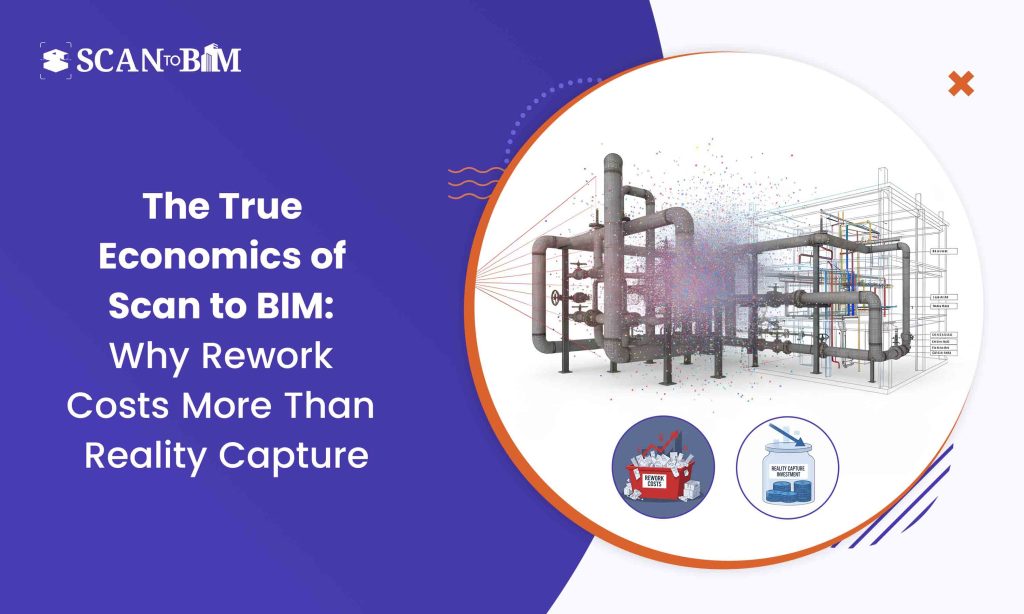
In an era where digital transformation is reshaping the AEC industry, the adoption of Scan to BIM processes is no longer a luxury — it’s a necessity. Yet, many stakeholders still hesitate, believing that the Scan to BIM services are costly. The truth is: Scan to BIM itself isn’t expensive — rework caused by the poor data capture, misinterpretation and low-quality deliverables is.
In this blog, we’ll explain the economics of Scan to BIM, why perceived costs are misleading, and how high-quality Point Cloud to Revit Services from a reputable Scan to BIM Company significantly reduces the project risks and costs.
What Is Scan to BIM? A Quick Technical Overview
Scan to BIM converts existing site conditions into a rich, data-driven digital model.
It typically involves:
- Laser scanning or LiDAR capture of the built environments
- Point cloud generation with millions of 3D data points
- Point Cloud to Revit Services to extract the geometry and metadata
- Creation of accurate, parametric BIM models with 3D geometry, attributes and asset data
Scan to BIM supports the renovation, retrofit, structural analysis, MEP coordination and facility management.
Why Do People Think Scan to BIM Is Expensive?
The misconception usually comes from the conflating upfront costs with the total project costs.
Common myths includes:
- “Laser scanning hardware is expensive”
- “High hourly rates for modelers”
- “Deliverables are difficult and time-consuming to produce”
While these points have some truth, they miss a critical insight: the real expense is not scanning — it’s rework.
The Hidden Cost: Rework
Rework is any correction or redesign work due to inaccuracies, missing data or misinterpretation. In construction, rework isn’t just inconvenient — it’s expensive.
Industry Insight:
According to the Construction Industry Institute (CII), rework accounts for up to 12% of total project cost and in some cases as high as 18% in complex projects.
Key drivers of rework includes:
- Inaccurate as-built information
- Poor coordination between disciplines
- Misaligned BIM and field conditions
- Unclear documentation
When rework occurs downstream — during design, procurement or construction — the cost multiplies exponentially.
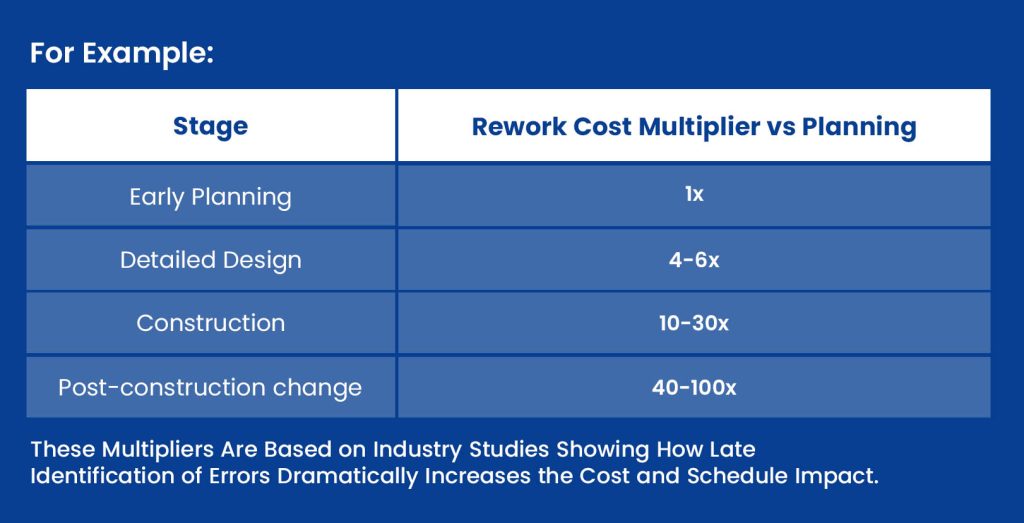
These multipliers are based on industry studies showing how late identification of errors dramatically increases the cost and schedule impact.
Scan to BIM: Expense vs. Value
- Initial Scanning and Modeling Costs
Point cloud capture and BIM modeling are charged based on the scope — area, complexity, deliverables and level of detail (LOD). Typical charges vary from:
- ₹15–₹40 per square foot for elementary scanning
- ₹60–₹150 per square foot for high-detail BIM models
Compare this to the cost of rework:
- A single day of field rework can cost ₹50,000–₹200,000+
- Delays due to inaccurate designs can result in penalties exceeding ₹1,000,000
Clearly, the upfront Scan to BIM investment is marginal compared to the risk of rework.
- Benefits of High-Quality Scan to BIM Deliverables
A professional Scan to BIM Company that provides the quality Point Cloud to Revit Services brings several cost-saving advantages:
Accurate As-Built Documentation
Accurate models eliminates the guesswork thus reducing the need for costly site verification and repeated surveys.
Improved Coordination
BIM models supports the clash detection across architecture, structure and MEP thus reducing the onsite conflicts.
Reduced Change Orders
Well-modeled as-built data leads to better design decisions, fewer RFIs and less reworks.
Faster Project Delivery
Data-rich models accelerates the analysis, costing, procurement and construction planning.
Real-World Case Study: Quantifying Savings
A renovation of a 50,000 sq. ft industrial facility presented unknown structural and MEP pathways. Initial engineering estimates projected 12 weeks of reworks and redesign due to incomplete field data.
By investing in:
- High-resolution laser scanning
- Detailed Point Cloud to Revit model with LOD 300
- Integrated clash detection and dimensional verification
The client reduced the rework to 2 weeks, saving approximately ₹2.3 million in labor and schedule costs — far surpassing the BIM investment. This illustrates that:
Investing in Scan to BIM upfront can reduces the total project expenses by 15–25% or more, primarily through avoiding reworks.
Best Practices to Minimize Rework Using Scan to BIM
To fully realize the scan-to-BIM value, projects should follow:
Standardize Data Capture
Define scanning protocols, resolution settings and control point placement for consistency.
Use Quality Software and Expert Modelers
High-precision tools and experienced modelers ensures accurate point cloud interpretation.
Define Clear BIM Deliverables
Agree on LOD (Level of Detail), LOI (Level of Information) and verification checkpoints.
Integrate BIM Early
Use BIM coordination at pre-construction stages for clash detection and schedule alignment.
Conclusion: The ROI of Scan to BIM
The AEC industry often underestimates the economic value of accurate as-built information. While scanning and modeling have upfront costs, these are minimal as compared to the expense of reworks including the delays, redesigns and field corrections.
When delivered with precision by a competent Scan to BIM Company, scan to BIM is an investment, not an expense. It prevents ambiguity, harmonizes workflows and significantly reduces the costly reworks.
Remember: The real question isn’t “How much does Scan to BIM cost?” — it’s “Can you afford the rework if you skip it?”