
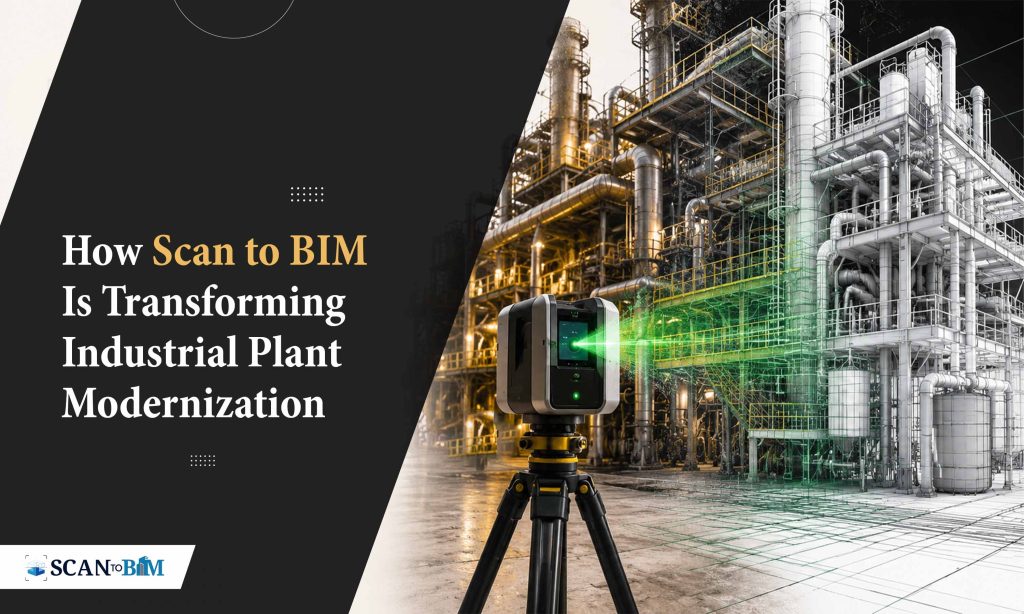
Industrial facilities are among the most complex environments to digitize. Unlike the conventional residential or commercial structures, industrial plants consist of dense mechanical systems, interconnected pipelines, heavy machinery, hazardous zones and continuously evolving layouts. This complexity has made Scan to BIM an essential process for industries aiming to modernize operations, improve maintenance planning and support future expansions.
As industries moves towards digital transformation and smart facility management, the demand for accurate as-built digital models has grown significantly. However, implementing Scan to BIM in industrial environments comes with challenges that extend far beyond traditional building projects.
Understanding Scan to BIM in Industrial Plants
Scan to BIM is the process of capturing existing site conditions through laser scanning technology and converting the collected data into intelligent BIM models. The process typically involves:
- Laser scanning or LiDAR data collection
- Point cloud generation
- Data registration and alignment
- BIM model creation
- Asset integration and documentation
In industrial projects, this workflow is used for:
- Plant retrofits
- Facility upgrades
- Maintenance planning
- Clash detection
- Asset management
- Digital twin development
Using advanced Scan to BIM Services, engineering teams can create highly detailed models that accurately represent complex industrial environments and operational systems.
Why Industrial Plants Are Different from Buildings?
Traditional buildings usually follows predictable architectural layouts. Industrial plants, however, contains:
- Intricate pipe routing systems
- Structural steel networks
- Equipment installed across multiple phases
- Restricted access zones
- High-temperature or hazardous environments
- Congested service corridors
These conditions creates unique obstacles during scanning, modeling and coordination.
Major Challenges in Industrial Scan to BIM Projects
- Dense and Congested Infrastructure
Industrial plants often contains thousands of interconnected components packed into limited spaces. Pipelines, ducts, cable trays, valves, pumps and equipment overlap across multiple elevations.
This congestion creates:
- Occluded scan areas
- Difficult line-of-sight conditions
- Incomplete point cloud data
- Complex modeling requirements
Capturing every asset accurately requires multiple scan positions and careful planning.
- Operational Constraints During Scanning
Unlike commercial buildings that may be vacant during surveying, industrial facilities usually remain operational.
This introduces challenges such as:
- Limited scanning windows
- Safety restrictions
- Moving machinery interference
- Vibrations affecting scan accuracy
- Restricted access to sensitive areas
In many facilities, scanning teams must coordinate closely with the plant managers to avoid disrupting production.
- Massive Point Cloud Data Volumes
Industrial scans generates enormous amounts of data. A large refinery or manufacturing plant may produce terabytes of point cloud information.
Managing this data becomes difficult because of:
- Heavy processing requirements
- Long registration times
- Storage limitations
- Performance issues during BIM conversion
This is where advanced Point Cloud Modeling Services become critical, helping teams to optimize, segment and convert the large datasets into manageable BIM environments.
- Aging Facilities with Missing Documentation
Many industrial plants were built decades ago and have undergone numerous undocumented modifications.
Common issues includes:
- Missing as-built drawings
- Inconsistent documentation
- Unrecorded equipment relocations
- Legacy systems no longer matching original plans
As a result, scan data often becomes the only reliable source of truth for creating accurate digital models.
- Complex MEP and Process Systems
Industrial facilities contains sophisticated process engineering systems that differs significantly from conventional MEP networks.
Examples includes:
- High-pressure pipelines
- Chemical processing systems
- HVAC systems for controlled environments
- Electrical substations
- Process automation equipment
Modeling these systems requires interdisciplinary coordination between the mechanical, electrical, structural and process engineering teams.
- Safety and Hazardous Environment Risks
Industrial sites may involve:
- Toxic chemicals
- Explosive atmospheres
- High-voltage zones
- Elevated structures
- Confined spaces
Scanning teams must follow strict safety protocols and often require specialized certifications before entering the operational areas.
Real-World Examples of Industrial Scan to BIM Applications
Chevron Refinery Modernization Projects
Chevron has used the laser scanning and BIM workflows during the refinery upgrades to improve the coordination and reduce the shutdown durations. By creating accurate digital models of existing refinery conditions, engineering teams were able to plan retrofits with fewer clashes and improved installation accuracy.
These digital workflows helped in reducing costly field modifications during the construction phases.
BMW Manufacturing Facility Digitization
BMW has implemented 3D scanning and BIM technologies across manufacturing facilities to support production planning and factory optimization. Digital plant models allowed the teams to analyze the equipment layouts, streamline the maintenance operations and improve the space utilization without disrupting the ongoing manufacturing activities.
The Growing Role of Digital Twins
Industrial Scan to BIM projects are increasingly becoming the foundation for digital twins.
By combining:
- Real-time sensor data
- BIM models
- IoT systems
- Facility management platforms
Industries can monitor operations more effectively and predict maintenance needs before failures occur.
According to industry reports, the global digital twin market is expected to grow rapidly over the next decade, driven largely by manufacturing, oil & gas and infrastructure sectors.
Best Practices for Successful Industrial Scan to BIM Projects
Plan Scan Positions Strategically
Careful planning minimizes blind spots and improves scan accuracy in congested environments.
Segment Large Facilities
Breaking facilities into zones improves data management and modeling efficiency.
Use High-Performance Data Processing Tools
Efficient software platforms are essential for handling massive industrial point cloud datasets.
Coordinate Across Disciplines Early
Early collaboration reduces conflicts between structural, mechanical and process systems.
Maintain Strict Quality Control
Industrial projects requires extremely high precision to avoid costly installation or operational errors.
The Future of Industrial Facility Digitization
As industrial facilities continues embracing the automation and smart manufacturing, Scan to BIM workflows will become increasingly important. Accurate digital models now support:
- Predictive maintenance
- Facility expansion planning
- Sustainability initiatives
- Operational efficiency
- Risk reduction
Industrial plants are no longer relying solely on outdated 2D drawings. Instead, they are transitioning towards intelligent digital ecosystems powered by accurate reality capture and BIM integration.
Conclusion
Scan to BIM for industrial plants is far more demanding than conventional building modeling. The complexity of industrial infrastructure, operational restrictions, massive data volumes and safety concerns requires specialized expertise and advanced workflows.
Despite these challenges, the long-term benefits are substantial. Accurate BIM models helps the industrial operators improve coordination, reduce downtime, optimize maintenances and support future-ready digital transformation initiatives.
As industries continues investing in modernization and smart facility management, Scan to BIM will remain a key driver of efficient and data-driven industrial operations.