

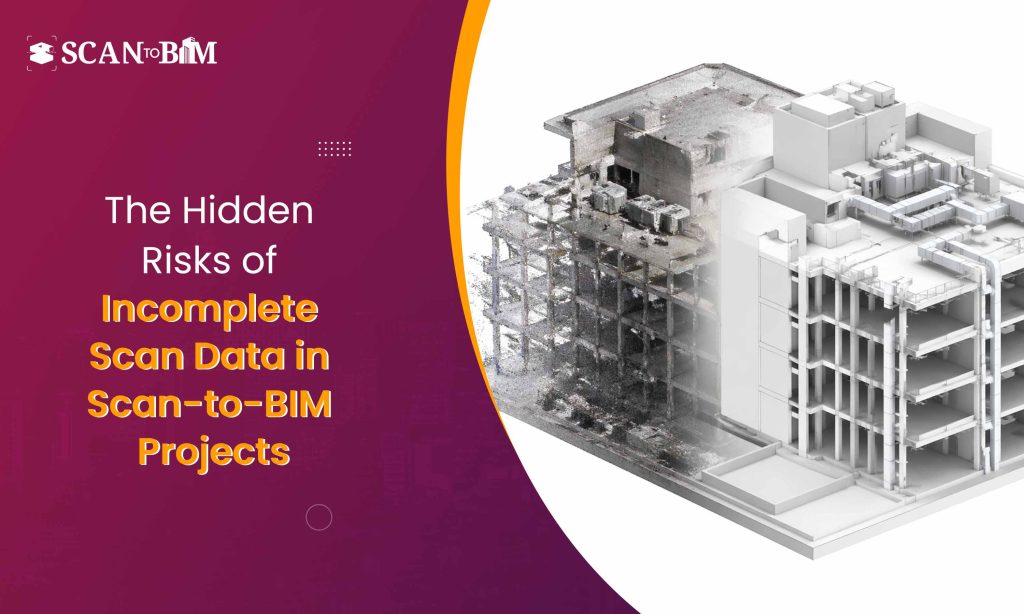
In modern reality capture and digital construction workflows, the scan data is the foundation of every successful BIM model. But what happens when that foundation is flawed? Incomplete scan data is one of the most common and costly challenges in Scan-to-BIM workflows, often leading to inaccurate models, reworks, delays and compromised decision-making.
This blog explores the real impact of incomplete scan data, backed by the industry insights and why working with an experienced Scan to BIM Company offering reliable Point Cloud Modeling Services is critical for project success.
Understanding Incomplete Scan Data
Incomplete scan data occurs when the portions of a building or site are not captured during the scanning process. This can happen due to:
- Occlusions (blocked views by walls, furniture or equipment)
- Poor scan planning or insufficient scan positions
- Low-resolution scanning or equipment limitations
- Environmental conditions (lighting, reflective surfaces)
These gaps result in missing geometry, distorted measurements and unreliable point clouds—the raw input for BIM modeling.
The Immediate Impact on BIM Models
- Missing Geometry & Data Gaps
When the scan data is incomplete, critical building elements simply don’t exist in the point cloud. This leads to:
- Missing walls, ceilings or MEP systems
- Inaccurate dimensions and spatial relationships
- Gaps in as-built documentation
Research shows that the incomplete datasets fail to capture the “critical elements and nuances,” thus leading to information gaps that reduces the model reliability.
- Modeling Errors & Misinterpretation
Modelers rely heavily on the scan data for accuracy. When the data is missing:
- Assumptions are made to fill gaps
- Geometry may be incorrectly interpreted
- Errors propagate across the BIM model
Noise and incomplete data can obscure the true structure thus causing discrepancies between the digital model as well as the real-world conditions.
- Increased Rework & Project Delays
One of the most direct consequences is rework:
- Teams must revisit the site for rescanning
- Multiple modeling iterations are required
- Coordination cycles increases
Incomplete or low-quality scans leads to “gaps in geometry” and “multiple rounds of reworks,” ultimately delaying the project delivery.
What Incomplete Scan Data Really Costs You?
- Cost Overruns
Reworks, site revisits and extended timelines translate directly into the higher costs. Even the minor scanning inaccuracies can escalate into major financial impacts during the construction.
- Clash Detection Failures
Incomplete data compromises one of BIM’s biggest advantages—clash detection:
- Hidden conflicts between the systems go unnoticed
- Issues emerges during the construction instead of the design
- Late-stage changes becomes expensive and disruptive
Conflicting geometry and unresolved interferences often surface only during the execution thereby causing the delays and revisions.
- Poor Decision-Making
A BIM model is only as reliable as its data. When scan data is incomplete:
- Stakeholders lose confidence in the model
- Design decisions are based on assumptions
- Project risks increase
Studies highlight that unreliable point cloud data leads to compromised decision-making across project phases.
Technical Challenges Behind the Problem
- Occlusions & Data Loss
Occlusions are a major cause of incomplete data. Complex building geometries and hidden elements make it difficult to capture all areas, especially in the renovation projects.
- Registration & Alignment Errors
Incomplete scans often leads to poor alignment between the datasets thereby increasing the registration errors and reducing the overall model accuracy.
- Lack of Scan Planning
Without proper planning, the critical areas are missed. Industry insights shows that the insufficient pre-scan planning results in the fragmented models and costly site revisits.
Real-World Example: A Domino Effect
Imagine a retrofit project where the ceiling-level MEP systems were not captured due to the poor scan coverage:
- The BIM model misses the ductwork and piping
- Designers assume the empty space and propose new systems
- During construction, clashes are discovered
- Work stops, redesign begins, costs escalate
This scenario is not uncommon—and it starts with the incomplete scan data.
How to Prevent Incomplete Scan Data?
To avoid these issues, industry best practices includes:
- Comprehensive scan planning to eliminate the blind spots
- Multiple scan positions and overlaps for full coverage
- High-resolution laser scanning equipment
- Rigorous data validation before the modeling
- Clear LOD (Level of Detail) and LOA (Level of Accuracy) definitions
Advanced workflows may also use multi-sensor data capture to reduce occlusions and improve completeness.
Why It Matters More Than Ever?
With BIM increasingly driving the digital construction, facility management and digital twins, the demand for accurate data is higher than ever. A single gap in the scan data can ripple across:
- Design coordination
- Construction execution
- Asset lifecycle management
Simply put, the incomplete scan data doesn’t just affects the modeling—it affects the entire project lifecycle.
Conclusion
Incomplete scan data is not just a minor technical issue—it’s a critical risk factor in the modern construction workflows. From the missing geometry and modeling errors to cost overruns and delayed timelines, the consequences can be significant.
The answer lies in the precision at the source. Investing in the proper scanning strategies and partnering with the experienced professionals ensures that your BIM model is built on the accurate, complete and reliable data.
Because in Scan-to-BIM, what you don’t capture can cost you the most.