
Construction sites remain one of the most complex and high-risk work environments in the built industry. According to the global construction safety reports, the construction sector accounts for over 20% of workplace fatalities worldwide, even though it represents a smaller portion of the global workforce. Many of these incidents occurs due to poor site planning, lack of visibility into the spatial constraints as well as miscommunication between the stakeholders.
As projects grow larger and more technically demanding, the traditional safety planning methods—based on the 2D drawings, manual risk assessments and static documentation—often fails to capture the real-world site complexities. This is where BIM is transforming the safety management by enabling teams to visualize, simulate and analyze the potential hazards before even the construction begins.
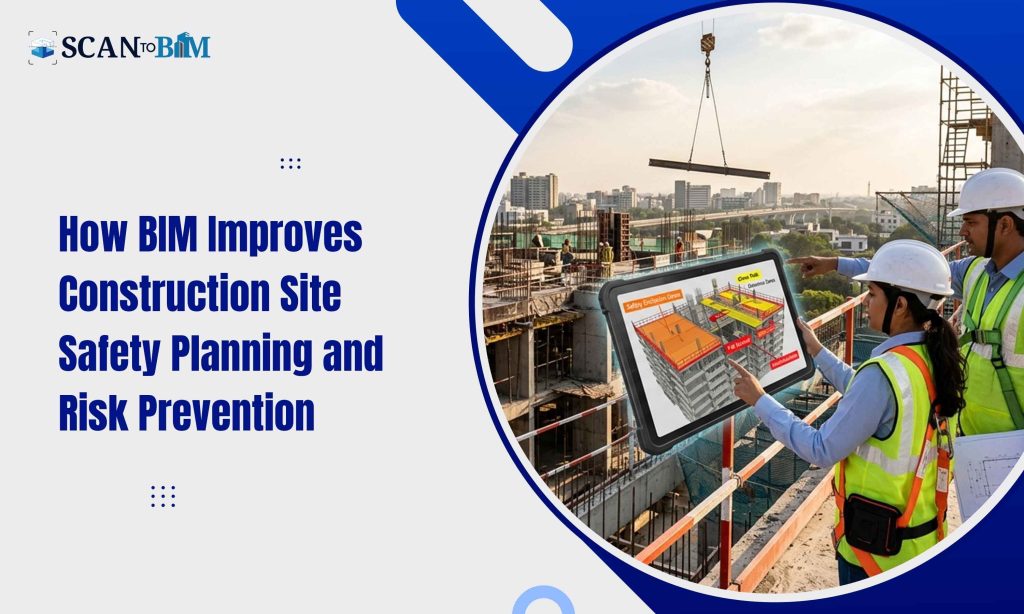
By integrating the safety planning directly into the digital model, the project teams can identify the risks early, optimize the site logistics and create a safer working environments.
Why Traditional Site Safety Planning Falls Short?
Historically, safety planning relied heavily on the experience, manual inspection and reactive responses after the risks were discovered on site. While these methods have worked to some extent, they present several limitations:
- Limited spatial visualization in 2D drawings
- Inability to simulate the construction sequences
- Poor coordination between the trades and safety teams
- Delayed hazard identification during the construction
- Reactive instead of proactive risk management
These limitations often leads to unforeseen conflicts, unsafe access paths, crane clashes or even hazardous material handling scenarios that could have been prevented earlier.
BIM introduces a data-rich and visual approach that allows the safety planning to evolve from the reactive measures to predictive risk management.
How BIM Improves Site Safety Planning?
- Visualizing Safety Risks in 3D
One of the most significant advantages of BIM is the ability to visualize the construction environment in three dimensions. Safety managers can examine the site conditions, structural elements, equipment placements and worker pathways within a realistic digital model.
This visualization allows the teams to identify the hazards such as:
- Restricted workspaces
- Conflicts between the heavy equipment and workers
- Unsafe access routes
- Potential fall zones or edge conditions
By detecting these risks before the construction begins, teams can implement the preventive measures early.
- 4D Construction Sequencing for Hazard Identification
BIM can integrate time-based simulation (4D BIM), linking the construction schedules with the model. This allows the teams to simulate each stage of the construction process and analyze how safety conditions evolves over the time.
For example, teams can evaluate:
- Crane movement and lifting zones
- Temporary structures and scaffolding placement
- Material storage locations during different phases
- Worker circulation paths during active construction
Through these simulations, planners can redesign the sequences that reduces the congestion and minimizes the potential hazards.
- Safer Site Logistics and Equipment Planning
Large construction sites often involves multiple cranes, heavy machinery and temporary installations. Poor site logistics planning frequently leads to collisions, unsafe material handling and restricted worker access.
BIM enables the planners to optimize site layouts by modeling:
- Crane swing paths
- Equipment movement corridors
- Safe worker zones
- Temporary operational spaces such as offices and storage facilities
With these insights, project teams can develop more efficient and safer site logistics strategies.
- Clash Detection to Prevent Dangerous Conflicts
Clash detection is commonly used to identify the conflicts between the architectural, structural and MEP systems. At the same time, it also plays a significant role in safety planning.
Potential safety issues detected through BIM coordination includes:
- Structural conflicts that could compromise the stability
- Equipment access conflicts
- Installation hazards for workers
- Inadequate clearance for maintenance or installation
By resolving these conflicts digitally, the teams prevents dangerous scenarios that might otherwise occur on-site.
- Integrating Real-World Conditions with Laser Scanning
Accurate site data is essential for effective safety planning. Existing structures, uneven terrain and undocumented site conditions often introduces the unexpected risks.
Using laser scanning and reality capture, the AEC teams can generate precise digital illustrations of the existing environments. This data is then converted into the BIM models through Point Cloud to BIM Services thus allowing the planners to evaluate the safety risks based on the real-world site conditions rather than just the assumptions.
Organizations partnering with an experienced Scan to BIM Company can ensure that their digital models accurately reflects the site environment thereby improving both the safety planning and the construction accuracy.
- Safety Training Using BIM Visualization
Another emerging benefits of BIM is its use in worker training and safety awareness. Instead of relying solely on the manuals or safety briefings, the teams can use the BIM models to demonstrate the potential hazards and safe work procedures.
Workers can visualize:
- Hazard zones
- Emergency evacuation routes
- Equipment operation areas
- High-risk construction phases
This improves the understanding and reduces the likelihood of accidents caused by the misinterpretation or lack of awareness.
- Digital Safety Documentation and Compliance
BIM models can also integrate the safety documentation and compliance requirements directly within the model environment. This allows the project teams to link the safety protocols with specific building components or construction phases.
Examples include:
- Fall protection requirements for elevated work areas
- Hazard warnings for confined spaces
- Safety guidelines for heavy lifting operations
- Emergency access routes and assembly points
Having safety information embedded within the model ensures that it remains accessible and consistent throughout the project’s lifecycle.
The Future of BIM in Construction Safety
As the digital technologies continues to evolve, BIM will increasingly integrate with advanced tools such as:
- AI-driven risk prediction
- IoT-enabled worker monitoring
- Digital twins for real-time site analysis
- AR/VR safety simulations
These innovations will further enhance the ability of the project teams to anticipate and mitigate safety risks before they occur.
Conclusion
Construction safety should never be reactive. The ability to anticipate the hazards, analyze the site conditions and optimize the workflows before any sort of physical work begins is critical for reducing incidents and protecting workers.
BIM enables this proactive approach by providing a digital environment where the teams can visualize risks, simulate construction processes and coordinate the safety measures across the disciplines. When combined with accurate site data and advanced modeling technologies, BIM transforms safety planning into a predictive and data-driven process.
As the industry continues to embrace digital transformation, leveraging BIM for safety planning will become an essential strategy for delivering safer, more efficient and more resilient construction projects.