

Introduction
Laser scanning has drastically changed the way existing buildings and infrastructures are documented. From renovation and restoration projects to facility management and industrial upgrades, point cloud data provides an accurate digital representation of real-world conditions. However, collecting millions of data points is only the first step. Converting that data into a structured, intelligent BIM model requires technical expertise, standardized workflows and careful quality control.
While point clouds capture existing conditions with remarkable precision, they also introduce several challenges that can impact the project timelines, model accuracy and downstream decision-making. Understanding these challenges and how experienced BIM professionals overcome them is quite essential for successful project execution.
This article explores the most common point cloud challenges and the proven methods BIM teams use to solve them.
Understanding Point Cloud Data
A point cloud is a digital dataset consisting of millions or even billions of spatial data points captured through laser scanning or photogrammetry. Every point represents an exact position in 3D space, enabling the creation of a detailed and accurate model of an existing building or asset.
Although point clouds provides comprehensive geometric information, they are not BIM models. The data must be interpreted, classified and converted into intelligent objects that includes walls, floors, structural components, MEP systems and other building elements.
This conversion process forms the foundation of Scan to BIM thus enabling the project teams to work with coordinated digital models rather than just the raw scanned data.
Common Point Cloud Challenges
- Massive Data Size
High-resolution laser scans often produce extremely large datasets. Multi-building campuses, industrial plants, airports and hospitals may generate hundreds of gigabytes of point cloud data.
Challenges includes:
- Slow file loading
- Reduced software performance
- Longer processing times
- Difficult collaboration across teams
Without efficient data management, project productivity can decline significantly.
- Registration Errors
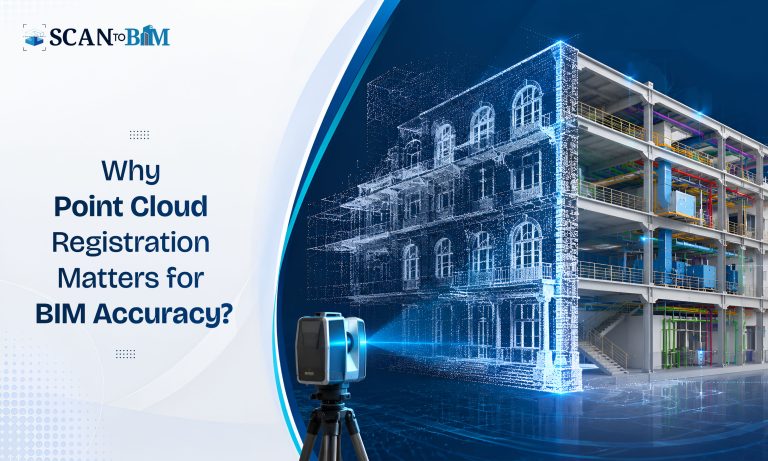
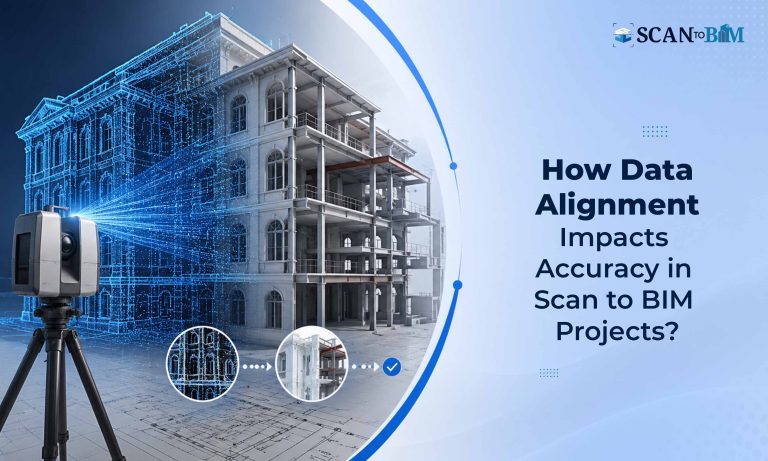
Large projects requires multiple scans captured from different locations. These scans must be accurately aligned, or “registered,” into a single coordinate system.
Poor registration can result in:
- Misaligned geometry
- Duplicate building elements
- Dimensional inaccuracies
- Modeling inconsistencies
Even small registration errors may affect fabrication drawings and construction coordination.
- Noise and Unwanted Objects
Point cloud datasets often comprises of irrelevant information like:
- People walking through scans
- Vehicles
- Construction equipment
- Vegetation
- Temporary materials
These unwanted points increases the modeling complexity and reduces the efficiency if not removed during preprocessing.
- Missing or Occluded Areas
Not every building component is visible during scanning. Equipment, furniture, walls, ceilings or inaccessible spaces may block the laser’s line of sight.
This creates:
- Data gaps
- Incomplete geometry
- Uncertain dimensions
- Additional assumptions during modeling
Experienced BIM teams must determine how to address the missing information without compromising on the model accuracy.
- Inconsistent Scan Quality
Scan quality can vary due to:
- Scanner settings
- Lighting conditions
- Surface reflectivity
- Distance from scanned objects
- Operator experience
Inconsistent density across the dataset makes accurate modeling more challenging, particularly for the detailed architectural or MEP elements.
- Complex Existing Conditions
Older buildings rarely matches the original drawings. Years of renovations, structural movement, undocumented modifications and aging infrastructure often create irregular conditions.
Point clouds reveals these deviations clearly, but translating them into practical BIM models requires careful interpretation and engineering judgment.
- Defining the Appropriate Level of Detail
One common misconception is that every visible point should become part of the BIM model.
In reality, modeling unnecessary details can:
- Increase project costs
- Extend delivery timelines
- Produce oversized BIM files
- Reduce usability
Successful projects defines the required Level of Development (LOD) before the modeling begins.
How BIM Teams Solve These Challenges?
Efficient Point Cloud Processing
Experienced BIM specialists divides large datasets into manageable regions, optimize file structures and use indexing techniques to improve the software performance. This enables smoother navigation and faster model creation without sacrificing accuracy.
Accurate Registration Validation
Professional workflows includes registration verification using control points, overlap analysis and quality reports. Each scan alignment is validated before the modeling begins to minimize the cumulative errors.
Intelligent Data Cleaning
Before modeling, BIM teams removes unnecessary scan information including temporary objects, duplicate points and excessive noise.
A clean dataset improves:
- Modeling speed
- Accuracy
- Software performance
- Overall project efficiency
Filling Data Gaps with Engineering Judgment
Where scans contains missing areas, BIM professionals combines available point cloud information with:
- Site photographs
- Existing drawings
- Client documentation
- Engineering assumptions
- Coordination meetings
Every modeled element is based on the documented project requirements rather than just the guesswork.
Modeling According to Project Requirements
Instead of converting every visible object, BIM teams focuses on the information needed for the project delivery.
Depending on project goals, they model:
- Architectural components
- Structural systems
- MEP services
- Equipment
- Building envelopes
- Site features
This ensures that the model remains practical, coordinated and efficient.
Rigorous Quality Control
Quality assurance is performed throughout the modeling process by comparing BIM elements directly against the point cloud.
Verification typically includes:
- Dimensional accuracy checks
- Clash reviews
- Element consistency
- Model completeness
- LOD compliance
- Naming and documentation standards
Continuous validation helps in reducing the errors before the project delivery.
Best Practices for Successful Point Cloud Projects
Organizations can significantly improve the project outcomes by following several best practices:
- Clearly define the project objectives before scanning begins.
- Specify required Level of Development (LOD) and modeling scope.
- Capture the sufficient scan overlap during fieldwork.
- Use experienced BIM professionals familiar with complex existing conditions.
- Establish quality control procedures throughout the modeling process.
- Maintain clear communication between the surveyors, designers and BIM teams.
These practices reduces the uncertainty and creates more reliable digital models.
The Value of Professional Point Cloud Conversion
Converting raw scan data into an intelligent BIM model involves far more than just the tracing geometry. It requires technical knowledge, modeling standards, coordination expertise and disciplined quality assurance.
Professional Point Cloud to BIM Services helps organizations to transform the complex scan datasets into accurate, information-rich models that support renovation, retrofit, clash detection, construction planning, facility management and even the long-term asset maintenance.
Conclusion
Point cloud technology has revolutionized the documentation of the existing buildings, but the raw data alone does not guarantee the project success. Large datasets, registration issues, incomplete scans, noise and inconsistent field conditions all requires the specialized expertise to overcome.
By implementing the structured workflows, robust quality control and project-specific modeling strategies, experienced BIM teams converts the complex point cloud data into reliable digital assets that improves collaboration, reduces reworks and supports better decision-making throughout the building lifecycle.
As the demand for renovation, modernization and digital asset management continues to grow, effective point cloud processing and BIM modeling will remain essential components of successful AEC projects.